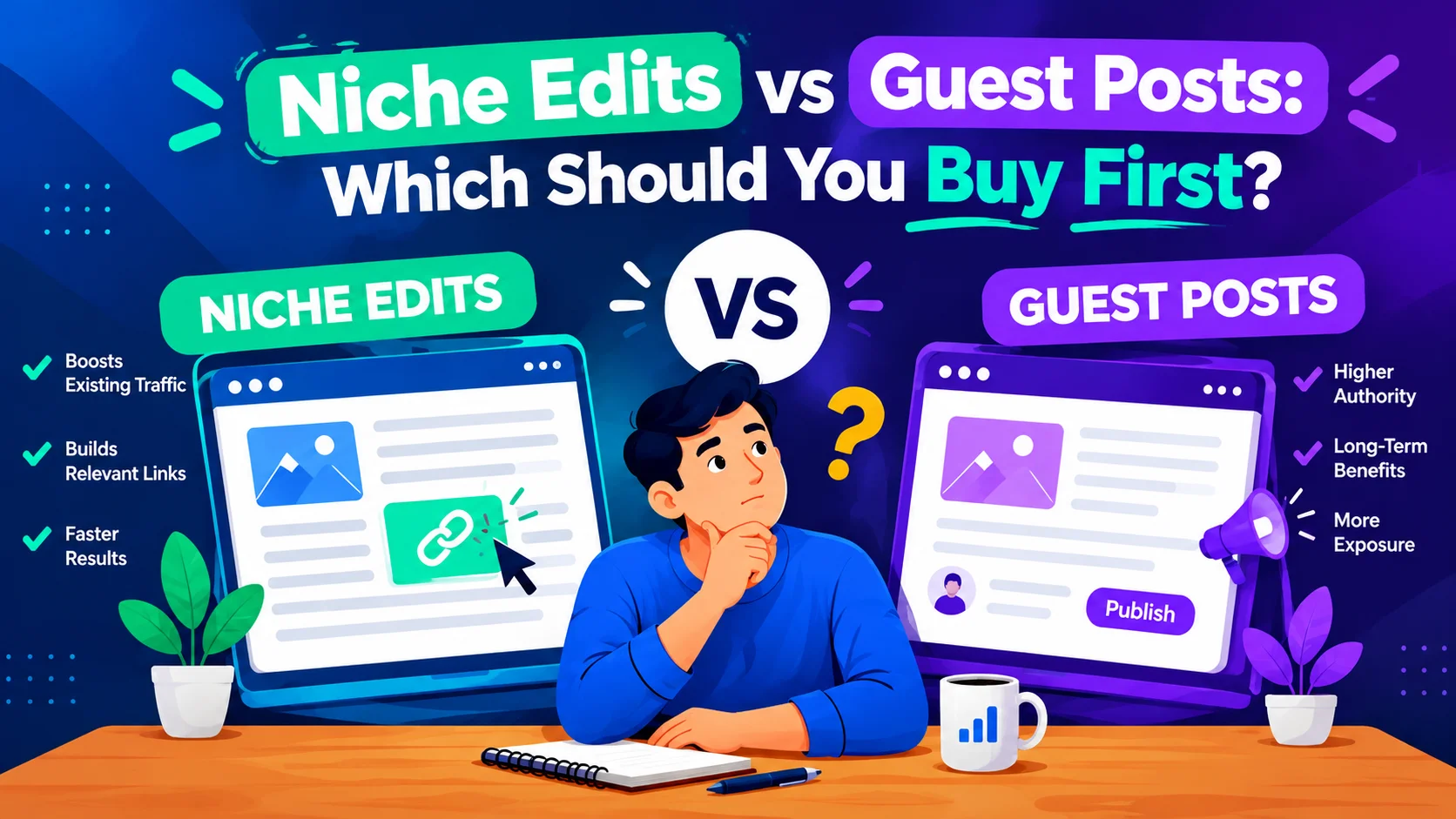
If you already have a page sitting on page two or three of Google, buy niche edits first. If your site is new, or you have almost no backlinks, buy guest posts first. Niche edits are usually faster and more budget-friendly per link. Guest posts take longer, but they build authority, brand visibility and a content footprint that niche edits can’t.
That’s the quick answer. If you’re about to invest in link building, read on. The wrong first purchase can cost you months.
What’s the Difference Between a Niche Edit and a Guest Post?
A guest post is a new article. You (or your link building partner) create it, a website publishes it, and it includes a link to your site. You usually choose the topic, and the link sits naturally inside the content.
A niche edit (also called a link insertion or curated link) adds your link to an article that’s already published and indexed. No new article is written. Your link is placed into a sentence or paragraph where it makes sense for the reader.
The core difference is simple. A niche edit goes on a page Google already knows and has history with. A guest post goes on a brand-new page that Google needs to find, crawl and evaluate. Almost every other difference, including speed, cost and control, comes from that.
Niche Edits vs Guest Posts: Side-by-Side Comparison
| Niche Edits | Guest Posts | |
| What you get | A link inside an existing article | A new article with a link to you |
| Cost level | Generally lower per link | Generally higher, since content is created |
| Speed to impact | Often 2 to 6 weeks | Often 6 to 12 weeks |
| Risk level | Low to medium | Low to medium |
| Content control | Low. You fit into what exists | High. You choose topic, angle and context |
| Link age | The page already has age and history | Starts fresh |
| Brand exposure | Limited, since it’s one link in someone else’s article | Strong, with a full article about your topic or brand |
| Scalability | Easier to order several quickly | Slower, since each needs writing and approval |
| Best for | Boosting pages that are close to ranking | Building authority from the ground up |
What Affects the Cost of Niche Edits and Guest Posts?
Prices vary a lot in link building, so it helps to know what you’re actually paying for:
Your industry. Finance, SaaS, legal and health niches usually cost more because publishers are stricter and demand is higher.
- Site traffic. A site with real, steady visitors costs more than one with almost none, and it should.
- Whether content is included. Some guest post packages include writing. Others only cover publishing. Always ask.
- Link type. Dofollow placements usually cost more than nofollow or sponsored ones.
- Location and audience. Sites that reach buyers in the US, UK and core EU markets generally cost more than generic global ones.
In general, niche edits cost less per link because there’s no new article to produce. But a link on a strong, relevant, high-traffic page can be just as valuable as a guest post, and priced accordingly.
A quick warning about very cheap offers
If a link seems suspiciously cheap, ask what’s missing. In most cases it’s a site that exists only to sell links: no real readers, no editorial standards, and a footprint Google can spot. At best, that link does nothing. At worst, it drags you down.
Which Is Faster: Niche Edits or Guest Posts?
Niche edits are usually faster. The page is already indexed, it may already have traffic, and Google already has an opinion of it. When your link gets added, it’s picked up quickly. Many people see early ranking movement within a few weeks, especially when the target page is already close to page one.
Guest posts take longer. The new article first needs to be published, crawled, indexed and given weight. After that, the link starts to carry value. A realistic timeline is one to three months before you see clear movement.
Two things to keep in mind:
- Neither is instant. Anyone promising page-one rankings in a week is selling you hope.
- Speed depends on your starting point. A page already in positions 11 to 20 will react faster than a page nobody has ever linked to.
Which Is Riskier?
Neither format is dangerous by itself. The risk comes from the site and the way the link is placed.
Google’s spam policies specifically target link schemes and large-scale, low-quality guest posting meant only to manipulate rankings. So the concern is not “guest posts” or “niche edits.” It’s careless guest posts and careless niche edits.
Warning signs on any site
- It publishes about everything: casinos, pets, crypto, insurance and recipes on the same blog
- The page or site gets no real organic traffic
- There are dozens of outbound links in a single article
- The site openly advertises paid links to anyone
- The same exact-match anchor text keeps appearing across your links
- The content around your link is thin, off-topic or clearly written just for links
Signs of a good placement
- The site covers your niche or a closely related one
- The page has real, steady traffic you can verify
- The link fits the sentence naturally, and a reader would actually click it
- The site has a real audience, editorial standards and a reasonable number of outbound links
- Your anchor text is varied: brand name, URL, partial match and the occasional keyword
Which has the slightly higher risk?
Niche edits can feel riskier because you’re relying on someone else’s existing article. If that page is weak, outdated or later changed, your link goes with it. Guest posts carry their own risk if the site is a link farm. Either way, the cure is the same: vet the site and the page before you pay.
Choose Niche Edits If…
- You have pages sitting on positions 11 to 30 that need a nudge
- You want faster impact and your timeline is short
- You’d rather spread a limited budget across several links
- You already have strong content and it just needs more authority
- You don’t have time to wait for new content to be written, approved and published
- You run a local or service business with a handful of key pages that matter most
Choose Guest Posts If…
- Your site is new, or has only a handful of backlinks
- You want brand awareness, not only a ranking boost
- You want control over the topic, angle and how your brand is described
- You’re building topical authority in one specific niche
- You want a link you can also point to as proof of credibility
- Your link profile looks one-sided and you want it to look more natural
Use Both If…
- You have a solid budget and a longer timeline
- You want rankings now and authority over time
- You want a more natural, varied backlink profile
What Should You Buy First? Three Real-World Examples
Example 1: A SaaS company in Austin. The pricing page and two blog posts are stuck around position 14. Start with niche edits. A few relevant links to those pages can push them over the line. Add guest posts later to build broader authority.
Example 2: A new ecommerce store in London. The site is three months old with almost no links and no rankings yet. Start with guest posts. You need a foundation and some brand mentions before small nudges mean anything. Add niche edits once pages start to climb.
Example 3: A B2B agency in Berlin. The site has decent authority, but its service pages don’t rank for the high-intent keywords. Start with a mix. A few niche edits to the service pages, plus a couple of guest posts on industry blogs your buyers actually read.
Not sure which one sounds like you? Send us your site and we’ll point you to the right option.
How to Vet a Site Before You Buy
Before you pay for any placement, run through this checklist:
- Check real traffic. Use a tool like Ahrefs or Semrush. Don’t trust DR or DA alone.
- Check traffic direction. A steady or growing line is good. A sharp drop is a red flag.
- Check the topic mix. Does the site stay focused, or publish on everything?
- Check outbound links. Too many outbound links per article dilutes everything.
- Check the audience. Is it read by people in the US or EU if that’s who you sell to?
- Read recent articles. Would you be proud to have your brand on that page?
- Check the page itself (niche edits). Is it indexed? Does it get traffic? Is the content current?
If you’d rather not do this yourself, that’s what our guest posting service and niche edits service take care of.
Common Mistakes People Make
- Buying purely on price. The cheapest option is rarely the best, especially in link building.
- Judging a site by DR alone. DR can be inflated. Traffic and relevance are harder to fake.
- Over-optimizing anchor text. If every link says your exact keyword, it looks unnatural.
- Pointing every link at the homepage. Spread links across the pages that actually matter.
- Expecting overnight results. Link building compounds over time. It rarely works in a week.
- Not tracking anything. Keep a record of what you bought, where it went and how rankings moved.
FAQs
What is the difference between a niche edit and guest posting?
A guest post is a new article published on another website with a link back to your site. A niche edit adds your link to an article that’s already published and indexed. Guest posts give you more control and a full piece of content. Niche edits are usually faster and a bit cheaper per link.
What are the top 10 guest posting sites?
There’s no single honest “top 10” list, because the best sites depend on your industry. A site that works for a SaaS brand is useless for a dental clinic. Anyone handing you a universal list is probably selling it.
A better approach is to look for sites that:
- Cover your topic or a close one
- Have real organic traffic, not just a high DR
- Publish editorial-quality content
- Are read by your target audience in the US or EU
- Keep outbound links per article reasonable
- Aren’t open to anyone with a credit card
Large publications, such as major industry news sites and well-known marketing blogs, do accept contributed content. But they’re selective and often prefer pitches to paid placements. For most businesses, a strong niche-relevant blog will deliver better results than a famous site that rarely says yes.
How much does guest posting cost?
It depends on the site, not on a fixed rate. The main factors are the site’s real traffic, your industry, whether the writing is included and the type of link you’re getting. Higher-authority sites in competitive niches like finance, SaaS and legal cost more than smaller niche blogs. Be cautious with offers that seem too cheap to be real, because they usually come from sites built only to sell links. For a clear quote based on your niche and goals, get in touch with us.
Does guest posting still work?
Yes, when it’s done properly. Google discourages link spam and mass-produced guest posting designed only to manipulate rankings. But a genuinely useful article on a relevant, real website still brings authority, referral traffic and brand mentions. What stopped working is the cheap, careless, high-volume version.
Are niche edits safe?
Yes, when they’re placed on relevant, trafficked, well-maintained pages. The risk comes from low-quality pages, over-optimized anchor text and sites that openly sell links to anyone.
How long do niche edits and guest posts take to show results?
Niche edits can show movement in a few weeks. Guest posts usually take one to three months. Both depend on your starting point, competition and link quality.
Final Takeaway
If you need speed and have pages close to ranking, start with niche edits. If you’re building authority from scratch, start with guest posts. If you can afford both, run them side by side.
Whichever you choose, spend more time checking the site than comparing prices. One link on a real, relevant site beats a handful of links on sites nobody visits.
Ready to decide? Explore our niche edits and guest post services, or talk to the Rank Outreach team and we’ll recommend the right mix for your site and budget.
