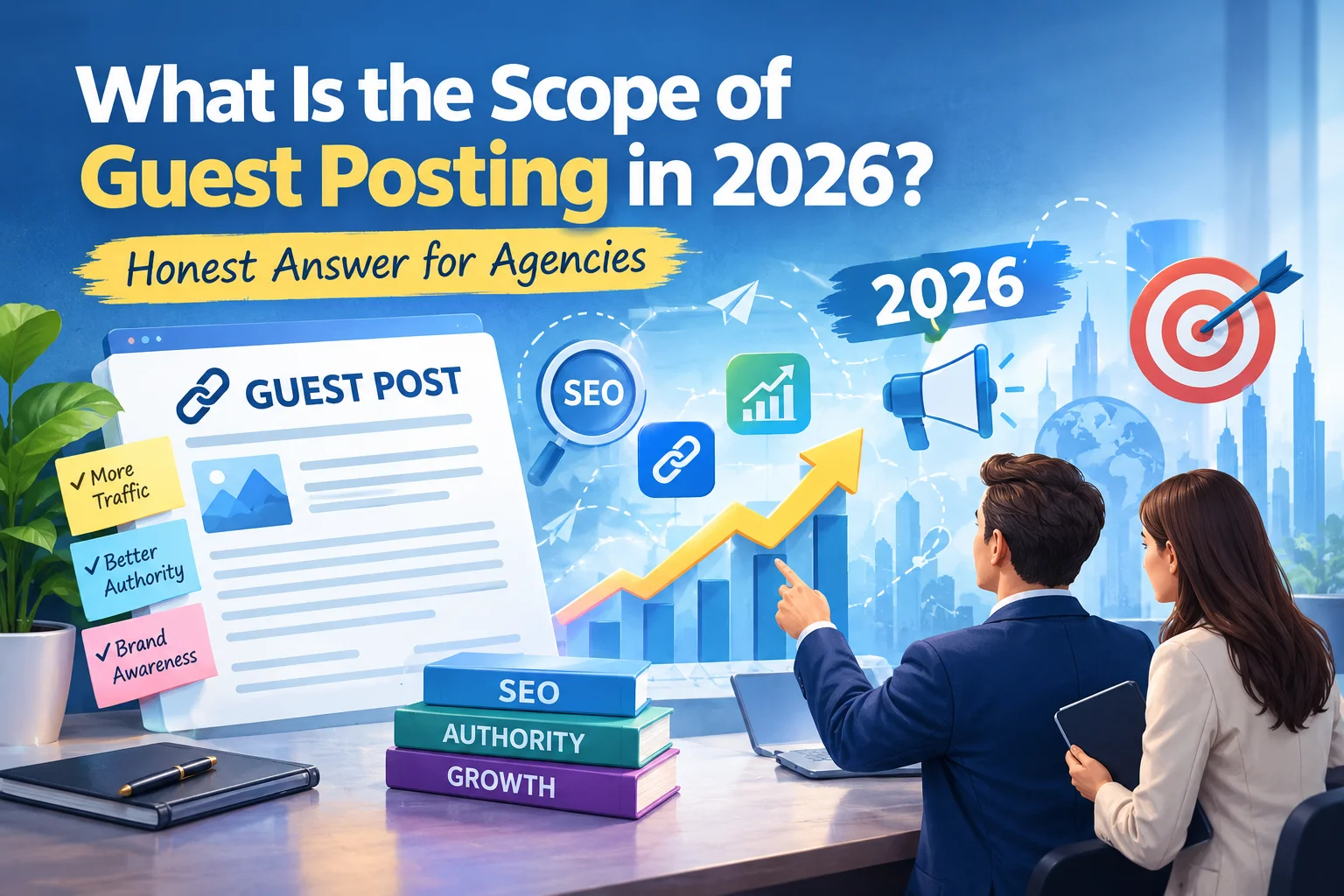
Guest posting still has plenty of scope in 2026, just not the scope it had in 2018. Nobody should treat it as a cheap way to stack links anymore. Today it earns its place by putting your brand in front of the right readers, getting your name mentioned on sites that Google and AI tools already trust, and picking up a link or two along the way.
We run link building for agencies and brands every week, so one question lands in our inbox again and again: “Is this still worth the money?” This post is our honest answer, including the parts that don’t exactly help a sales pitch.
What is guest posting, in plain English?
Guest posting means writing an article for a website you don’t own, so that the site’s readers get to know you and, usually, you earn a mention or a link back. People also call it guest blogging or contributed content.
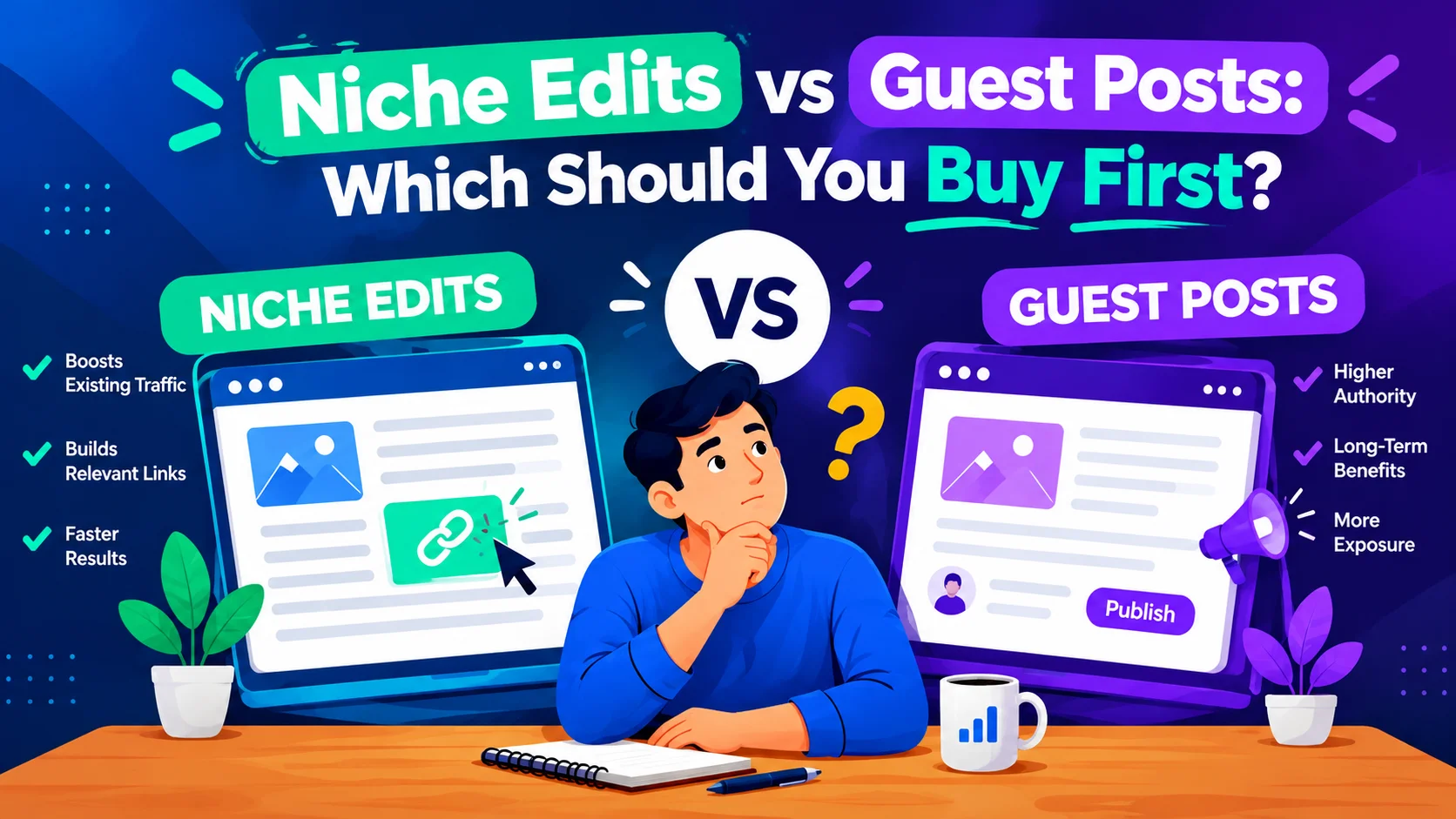
It shows up in three forms. Some posts are pure editorial: you pitch, the editor likes the idea, nobody pays anyone. Some are sponsored: money changes hands, and the link is really an ad, whatever it looks like. And then there are niche edits, where your link gets slotted into an article that already exists and is already indexed. We explain how those work on our niche edits page.
All three are chasing the same thing: a reader who trusts the site they’re on starts to trust you a little too.
What is the scope of guest posting in 2026?
The scope is five jobs, and the order matters. Links used to be job number one. Now they’re often job number four or five.
It builds authority readers can feel
When a SaaS founder’s name shows up on three respected industry blogs, prospects notice before any ranking tool does. That kind of familiarity is hard to buy with ads, because it comes from someone else vouching for you.
It gets your brand into AI answers
This is the biggest shift of the last two years. Tools like Google’s AI Overviews, ChatGPT, and Perplexity draw on pages from all over the web, and they can name your brand whether or not a link is attached. Research cited by Ranktracker found that branded mentions track more closely with AI visibility than backlinks alone. So a post that gets your name discussed in the right company is doing real work, even if the link is nofollow.
It still helps rankings if the site deserves it
Backlinks remain a major ranking signal. What changed is how selective Google is. One link from a relevant site with real readers can outweigh a pile of links from sites that exist only to sell them.
It sends actual visitors
The Stackmatix team makes a good point: the value has moved from the link itself to the audience you reach. If the host site’s readers are the people who buy from you, a single post can bring demo requests and newsletter signups for months.
It gives agencies something they can repeat
For an agency juggling a dozen clients, guest posting is one of the few link tactics that is predictable and easy to report on. That only holds if every placement is checked by a human first. More on that below.
What’s no longer in scope: mass-emailed pitches, spun or lazily AI-generated articles, sites that take any topic from anyone, and anything that comes from a private blog network. Those cost more than they return now.
Is guest posting still worth it in 2026?
Yes, as long as you pick the sites carefully and keep your expectations realistic. We sell this service, so feel free to read this section with a raised eyebrow. Here’s what we’d tell a friend.
First, practitioners don’t rate it as the top tactic. In Editorial.Link’s 2026 survey of 518 SEO professionals, about 16% called guest posting the most effective link tactic, while digital PR came first at roughly 49%. Guest posting is a solid player on the team, not the whole team.
Second, Google hasn’t relaxed. Its spam policies count buying or selling links for ranking purposes as link spam, and that includes guest posts and advertorials with optimized anchor text. Paid links are fine with Google when they carry a rel=“sponsored” or rel=“nofollow” tag.
Put those together, and you get an uncomfortable truth: no vendor can honestly promise you zero risk. Anyone who says “100% safe” is selling you something. What you can control is the quality of the site, how natural your anchors look, and how fast you build. If you want to check a site yourself before paying, our 9-point vetting checklist walks you through it.
How is guest posting different now from a few years ago?
The old playbook was simple: find a site with a big DR number, pay a small fee, drop in an exact-match anchor, repeat fifty times. It worked well enough that people got lazy, and Google noticed.
The 2026 version flips most of that. You start with the reader instead of the metric. You pick fewer sites and care more about who visits them. You write something the editor would be glad to publish even if your link vanished. And you judge success by traffic, branded searches and rankings over a few months, not by how many links went live on Friday.
Who should actually invest in guest posting?
Agencies, SaaS companies and service businesses selling to US and UK buyers get the most out of it. Here’s why each one tends to benefit.
Picture an agency owner with twelve clients and a monthly report due. She needs placements she can show without crossing her fingers about what sits behind them. White-label guest posts on checked sites give her that.
Picture a SaaS founder whose product looks like fifteen other products. Buyers read comparison articles and industry blogs before they ever visit his pricing page. Being quoted or featured there does more than another round of ads.
And picture a service business in a crowded niche, say a law firm or a B2B consultancy. Trust is the whole sale. A well-placed article from a real expert on a respected site is worth more than ten generic directory listings.
One warning, though. If your own site is brand new, thin, or technically broken, fix that first. A guest post can point people to your site, but it can’t make a weak site strong.
How do you do guest posting well in 2026?
Start small and be deliberate. This is the order we’d follow.
- Pick one goal. Ranking a specific page, building brand awareness, and generating leads call for different sites. Decide before you shortlist anything.
- Shortlist sites your customers actually read. Real organic traffic and topic fit come first. DR is a tiebreaker, not a starting point.
- Vet every site by hand. Check the outbound links, the backlink history, the footprints, and whether the pages get indexed. Expect to reject more sites than you keep.
- Pitch an idea, not a link. Editors get dozens of requests a week. The ones that win offer a fresh angle, a clear how-to or a bit of original data.
- Write for the host’s reader. Cite your sources, give specific advice, keep the bio honest, and place your link where it genuinely helps.
- Follow up after it goes live. Confirm the post is indexed and the link is still there, then watch referral traffic and rankings over the next few months.
If you’d rather not do all that yourself, our team handles guest post writing and outreach start to finish.
How many guest posts do you need?
Fewer than you probably think. For a startup or a small B2B brand, a handful of strong placements a quarter can beat a dozen weak ones. Agencies will build more across clients, but the same rule applies to each client: steady, relevant and varied looks natural, while a sudden burst of identical anchors does not.
What guest posting mistakes do we see most?
- Chasing DR and ignoring traffic. A high score on a site nobody visits is decoration.
- Repeating the same anchor text. If every link says the same keyword, it looks planned because it was.
- Using sites that accept every niche. A page that hosts casino, health, and SaaS posts side by side is a red flag.
- Sending one pitch to hundreds of editors. Editors can smell a template from the subject line.
- Never checking the result. Links get removed, and pages go unindexed. Check them at 30 and 90 days.
- Relying on guest posting alone. It works best next to digital PR, brand mentions, and solid content on your own site.
Are blogs still worth it in 2026?
Yes, but only blogs that say something worth reading. AI Overviews and chatbots now answer plenty of simple questions before anyone clicks, so posts that repeat what everyone already knows earn less traffic than they used to. Posts built on first-hand experience, original data or a clear opinion still rank, still get cited by AI tools, and still bring in leads.
A few honest expectations help here. New blogs tend to need somewhere between six and twelve months to build momentum, so judging yours at month three is the most common way people quit too early. One deep, well-structured article beats five thin ones. And your blog works best alongside outside proof. Your blog is where you control the story; guest posts let other sites vouch for it.
If the writing is what holds you back, see our blog writing service.
What is the best way to advertise in 2026?
There’s no single best way, because the right channel depends on what you need and how quickly you need it. A rule we like: pay for speed, earn for trust.
| If you need… | Lean on… | Why |
| Customers this month | Paid search and retargeting | You catch people who are already looking to buy |
| Demand for something new | Social and video ads, creators | You reach people who don’t know they need you yet |
| Trust that lasts | Guest posts, digital PR, brand mentions, a strong blog | Other people vouching for you keeps working after the spend stops |
| More from existing customers | Email and community | It’s the cheapest way to sell again |
Most agencies and SaaS brands end up with a mix: paid channels to get leads now, and earned channels like content and guest posts to build visibility that compounds. Ads stop the day you stop paying. A good placement on a respected site can keep sending readers for years.
Where Rank Outreach fits in
We’re a small team that places guest posts and niche edits for agencies, SaaS brands, and businesses across the US and UK. We pick each publisher by hand, check it for real organic traffic, a clean history and solid Ahrefs numbers, write the article in-house, and pitch the editor ourselves, one to one. No PBNs, no bots, no mass-blasted emails. When the link is live and indexed, you get a clean white-label report you can forward straight to your client.
If you’d like a plan built around your niche, goals and budget, talk to our team or take a look at our guest post service.
Frequently asked questions
What is the scope of guest posting in 2026?
Guest posting in 2026 works as a brand-authority, referral-traffic and AI-visibility channel as well as a link-building tactic. It performs best on relevant sites with real readers and sits well alongside digital PR, brand mentions and strong content on your own site. Mass-produced, low-quality posts are no longer worth it.
What is a guest post?
It’s an article you write and publish on someone else’s website, usually in your industry, so that site’s audience gets to know you and you earn a mention or a link to your own site. You’ll also hear it called guest blogging.
What is the best way to advertise in 2026?
There isn’t one. Use paid search and retargeting when you need leads fast, social and video ads to create new demand, and earned channels like guest posts, digital PR and a strong blog to build trust that lasts. Match the channel to your goal and your budget.
Are blogs still worth it in 2026?
Yes, when they offer something an AI summary can’t: first-hand experience, original data, or a point of view. Plan on several months before you see results, publish fewer and deeper posts, and back them up with outside mentions such as guest posts.
Is guest posting dead?
Cheap, mass-produced guest posting is. Relevant posts on real sites still bring authority, referral traffic, and brand mentions, and they can still support rankings.
Do guest posts help you show up in ChatGPT or Google AI Overviews?
They can help. AI tools pull from third-party pages, and a credible mention of your brand seems to matter about as much as a link. A relevant guest post puts your name in the right context, but nobody can promise a specific AI citation.
Should guest post links be dofollow or nofollow?
Google is comfortable with paid links that carry rel=“sponsored” or rel=“nofollow”, and a relevant nofollow link can still bring traffic and brand exposure. Many brands prefer dofollow for the ranking value and accept the extra risk. Pick based on your own risk tolerance, and if you’re an agency, tell your client plainly which one you chose.
How much does a guest post cost?
It depends on the site’s traffic, niche and quality, so prices vary a lot. Be wary of very cheap “DR 70” offers. Ask to see real organic traffic and a few live examples before you compare quotes.
Is guest posting better than digital PR?
Neither wins every time. Digital PR tends to earn stronger editorial links but takes more effort and is harder to predict. Guest posting gives you more control over topic and timing. Plenty of brands run both.
Final thoughts
Guest posting in 2026 isn’t a shortcut, and it isn’t dead either. It rewards patience, relevance and a bit of care. Choose fewer, better sites, write something readers genuinely want, and measure more than the link itself.
If you’d like someone else to handle the vetting, writing and outreach, get in touch with Rank Outreach, and we’ll build a plan around what you’re trying to achieve.