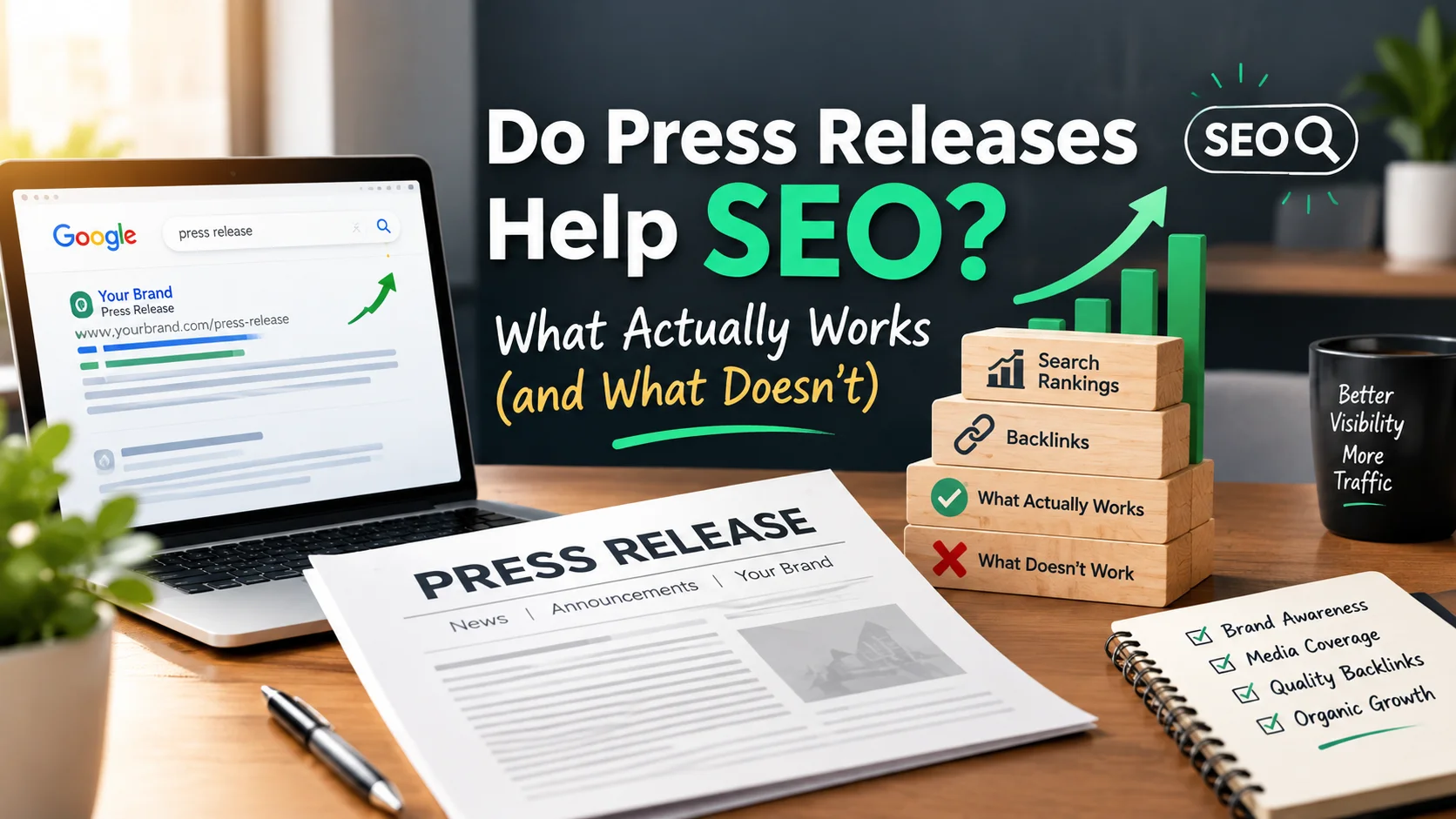
Not directly, no. If you’re hoping a press release will push your site up the rankings by itself, it won’t. The links inside most press releases don’t pass any real SEO value.
But that’s only half the story. A press release can still help your SEO indirectly, if it gets your brand talked about by real publications. That’s where the value is. The release is just the way in.
I’ll walk you through what’s true, what’s hype, and how to get something out of a press release without wasting your budget.
The quick version
Here’s where press releases help and where they don’t, in one glance:
| Does it help? | |
| Ranking boost from links inside the release | Rarely |
| Getting your brand name in front of people | Yes, if the story gets picked up |
| More people searching for your brand | Often, over time |
| Real backlinks from news and industry sites | Yes, but only when journalists write their own story |
| Showing up in AI answers (ChatGPT, Perplexity, AI Overviews) | It can help |
| A fast jump for a keyword you’re targeting | No |
Why the old press release trick stopped working
Years ago, people would write a release, stuff it with keyword links, blast it out to a distribution network, and wait for rankings to climb. For a while, it kind of worked.
Then Google caught on. Today, most of those distribution sites mark their links so they don’t count, or Google simply gives them almost no weight. Google’s own spam guidelines even call out keyword-heavy links in press releases spread across other sites.
There’s also a duplicate problem. When the same release shows up on fifty sites nobody reads, Google doesn’t see fifty votes for you. It sees one piece of content copied around.
So if a vendor tells you a press release will bring you “dozens of backlinks” and a ranking jump, I’d be careful. The report might look impressive. The results usually don’t.
Can you really “turn press releases into Google ranking gold”?
You’ll see that promise all over YouTube and LinkedIn. And honestly, it’s catchy. But the release itself isn’t the gold.
What’s valuable is what the release leads to. Say you announce something genuinely interesting. A journalist reads it, likes it, and writes their own article. A couple of industry blogs mention you. One of them links to your site.
Those links, from real sites with real readers, are what Google actually cares about. The press release just made the introduction.
Think of it like sending an invite to a party. The invite doesn’t make the party good. It just gets people there.
Where a press release really does help
Your brand gets seen in more places. When your name keeps showing up on credible sites, people start to recognize it. Google can pick up on that too, even when there isn’t a link attached.
More people search for you by name. A good announcement makes people curious. Some will Google your brand directly, and growing branded search is a healthy sign for any site.
You can earn real backlinks. This is the best-case result, and it depends on the story, not the distribution. A journalist who finds your news useful might link to you in their own piece.
AI tools notice you more. This one is newer. Tools like ChatGPT, Perplexity and Google’s AI Overviews tend to rely on brands mentioned across several trusted sources. More credible coverage gives you a better chance of being included. Nobody can promise it, but it’s a real upside that old press release advice never mentioned.
Local businesses get a nice boost. If you’re opening a second location, sponsoring a community event, or launching something in your city, local news sites and community blogs often pick it up. Those mentions support your local visibility.
Where it doesn’t help
A press release won’t do much if there’s nothing newsworthy in it. “We’re excited to announce our new website” is a good example. Nobody outside your company cares.
It also won’t help if it’s stuffed with keywords, sent only to sites no one visits, or treated as a one-time effort. And it definitely won’t give you a quick ranking jump for a competitive keyword. Anyone saying otherwise is selling you something.
What makes a story worth sending out?
Ask yourself one question: would a journalist in my industry actually care?
If you launched something new that solves a real problem, yes. If you ran a survey and found something surprising, definitely. A big partnership, a funding round, an award, an event or a notable new hire can all work too. A timely expert take on something happening in your industry sometimes does better than a plain announcement.
If your honest answer is “probably not,” then it’s better as a post on your own blog. There’s nothing wrong with that. It just isn’t a press release.
How to get real SEO value out of one
Start with the story. If the news is weak, nothing else will fix it.
Write it like you’d explain it to a smart friend. Lead with what happened, keep it clear and cut the hype. Journalists get hundreds of releases and can spot filler in seconds.
Link to your site naturally, using your brand name or the page URL. Skip the exact-match keyword anchors. Add something people can quote, like a number, a finding or a clear statement from someone at your company. That gives journalists a reason to use you.
Publish the full release on your own site as well, so there’s one strong, original version you control. Then send it to outlets your buyers actually read, whether that’s industry sites in the US or Europe, local news or trade blogs. A short, personal note to a journalist who covers your topic beats a mass blast almost every time.
After it goes out, keep an eye on what happens. Look for new mentions, new backlinks, referral traffic and whether more people are searching for your brand.
Where press releases fit with other link building
A press release isn’t a replacement for guest posts or niche edits. It does a different job.
Press releases create awareness and give the media something to talk about. Guest posts and niche edits place links on relevant sites you choose. If you’re weighing those two, we wrote a guide on niche edits vs guest posts that helps you decide. And digital PR goes a step further, building stories and data that journalists want to cover.
Most strong strategies use a mix. The release creates the story, and the links from real coverage back it up.
So, is a press release worth it for you?
It probably is if you have real news, want more credibility, are launching something or are happy to pitch journalists and follow up.
It probably isn’t if all you want is a quick keyword boost, you’ve got nothing newsworthy to say, or you’re expecting the distribution network to do the work.
FAQs
Do press releases help SEO?
Not directly. The links inside distributed releases usually don’t pass ranking value. They can help indirectly by earning media coverage, brand mentions, more branded searches, and visibility in AI answers.
Do press releases give you backlinks?
Sometimes, but not the way people think. Links inside the release itself are usually ignored. The valuable backlinks come from journalists and publishers who write their own story about you and link to it.
Are press release links nofollow?
On most distribution platforms, they are, or they’re treated in a way that doesn’t pass authority. Even when they aren’t technically nofollow, Google may give them very little weight. I wouldn’t count on the release itself for link value.
How do press releases help local SEO?
For local businesses, coverage in local news, community sites and regional blogs reinforces your name, location, and reputation. It can also bring local referral traffic and more branded searches, and both support your local visibility.
Do press releases help with AI search?
They can. AI tools tend to mention brands that show up across several credible sources. A well-covered announcement puts your name in more trusted places, which improves your odds. It’s never guaranteed.
How often should you publish a press release?
Only when there’s real news. For many businesses, that’s a few times a year. One strong release beats ten weak ones.
Can a press release hurt my SEO?
It’s unlikely to cause damage by itself. But stuffed keywords, aggressive anchor text and mass distribution to low-quality sites can look manipulative. Keep it honest and natural.
Is a press release better than guest posting?
They do different jobs. A press release builds awareness and can earn coverage. Guest posts place links on relevant sites you choose. Plenty of brands use both.
The bottom line
A press release isn’t an SEO shortcut. It’s a way to put your story in front of people who can spread it, and that spread, in the form of coverage, mentions and links from real publishers, is what helps your SEO.
Get the story right, pick the right outlets, and a press release can do a lot for your brand. Skip those two things, and no distribution network will save it.
Want help getting real coverage, not just a published release? Check out our press release service or contact Rank Outreach for a free quote, and we’ll help you plan one that earns attention.
